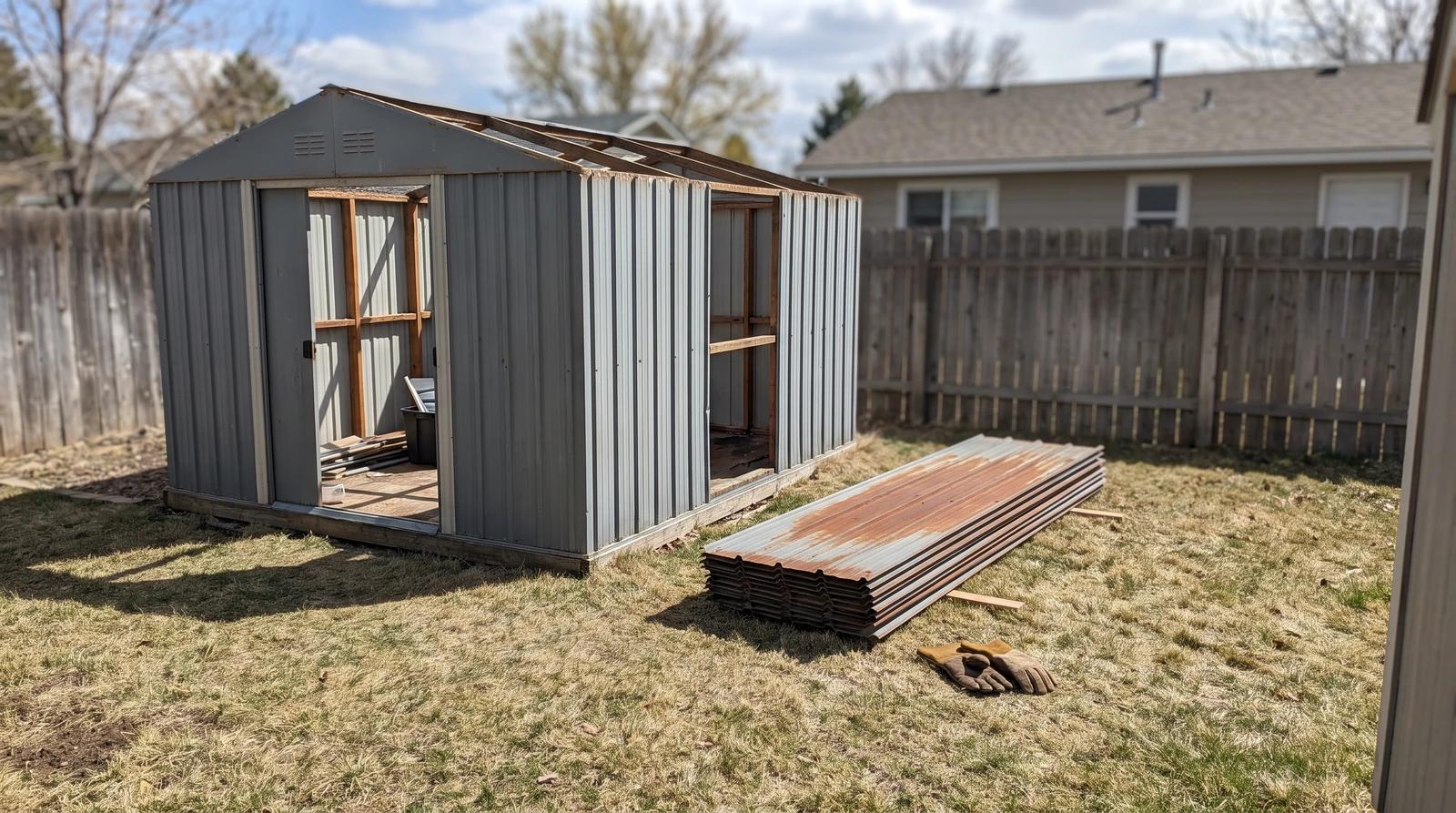
Metal Shed Removal in Boise: Taking Down an Old Steel Shed
Last spring we pulled up to a shed removal job in Boise, up on the Bench, and the homeowner had already gotten a head start. One wall panel was off. The rest of the metal shed was leaning about ten degrees toward the fence.
They'd stopped because it creaked every time the wind picked up. Smart call.
That's a pretty common place for a metal shed to end up. If you're reading about metal shed removal in Boise, you've probably got one of those thin steel kits from 15 or 20 years ago, and it's rusting at the seams.
So here's what taking one down really involves, what tends to go wrong, and when it makes sense to hand it off.
Why metal sheds come apart differently
A wood shed is heavy and stubborn. A metal shed is light and unpredictable.
Most older kit sheds around the Treasure Valley hold their shape with hundreds of small screws and a thin frame that only works when every panel is in place. Pull one wall and the whole thing loses its stiffness. That's exactly why the one on the Bench started leaning.
The edges are the other problem. Sheet steel that's sat through a few Boise summers and freezing winters gets brittle around the rust, and when it tears, it tears sharp.
We wear heavy gloves on every job. Metal sheds still find a way to nick us.
Then there's the wind. A loose roof panel on a breezy afternoon in Kuna or Star turns into a sail. Ever chased one across a yard? It's not fun.
What metal shed removal in Boise actually looks like
How do you take one down without it folding over on somebody? Mostly by going in reverse of how it went up.
First we empty it. Half-used paint cans, old fertilizer, a mower with gas still in the tank. Some of that can't ride along on a regular run to the Ada County landfill, so we sort as we go.
Then the roof comes off, while the walls are still holding the frame square. After that the walls come down one section at a time and the frame gets unbolted or cut. Rusted screws rarely back out, so we usually just cut them.
The base is last. Some metal sheds sit on a wood floor kit, some on pavers, and some on a concrete pad with anchor bolts.
The floor is often the slowest part. The wood under there has been soaking up sprinkler water for years, and it doesn't come up in nice clean pieces.
A typical backyard metal shed takes our crew an hour or two. Bigger ones, or ones with a rotted floor, take longer. We'll tell you which kind you've got when we come look.
Tip: Before anyone touches the shed, walk around it and look for a wire running in or a conduit coming up out of the ground. A lot of sheds in Meridian and Eagle got a light or an outlet added by a previous owner. If yours has power, have an electrician disconnect it first, and check with your city about whether you need a permit.
Most of it gets recycled
This part surprises people. A metal shed is one of the easiest things we take down to keep out of the landfill.
The steel panels and frame go to scrap recycling, and rust doesn't change that. A floor in decent shape can sometimes be reused. Shelving, workbenches and tools that still work get donated when we can find them a home.
What's left is usually small. A few rotten boards, maybe some insulation somebody stapled up, and whatever junk was stored inside.
On a job in Nampa last year, the whole shed went to scrap except one sheet of particle board. Not every job goes that clean, but it happens more than you'd think.
DIY or call a crew for shed removal in Boise?
Yes, we'd like the work. But honestly, plenty of people take down a small metal shed on their own and do just fine.
If it's small, not wired, not leaning, and you've got a helper and a free Saturday, go for it. Wear real gloves and eye protection. Pick a calm morning, and take the roof off first.
It's worth calling someone when the shed is already twisted, the roof has caved in, or it's jammed up against a fence or a neighbor's property line.
Hauling is the other big one. A pile of sharp, bent steel doesn't fit in the back of a car, and it'll chew up anything it touches on the way.
As for cost, it depends on the size of the shed, what's stored inside and what's sitting under it. We price by the space and the work involved, not off a chart. That's why we come out first and give you a firm price before anything gets touched, with no hidden fees tacked on later.
What we see each season
Spring is the busy stretch. Folks clean out the garage, open the shed, and find a mouse nest and a leaky roof. That's usually when they decide it's time.
Summer jobs out in Caldwell and Middleton go better early. Steel panels sitting in the July sun get hot enough to burn through a glove.
Winter's quieter, which isn't bad if you're flexible. Frozen ground makes pulling anchors harder, but the calendar opens up. Most demolition gets scheduled within a few days of the estimate, and we do same-day when there's room.
Bottom line: a metal shed looks simple until one panel comes off and the rest starts to lean. If yours is small and solid, you can probably handle it yourself.
If it's rusted through, wired, or wedged into a tight corner, have someone who does shed removal in Boise every week take a look.
Want a firm price? Give us a call at (208) 279-2738. We'll come out, look at the shed and tell you what it involves, no pressure either way. Cash, card and Venmo all work.
Want a Free Quote?
We'll come look at your shed and give you a firm price. No pressure, no obligation. Then you can decide if DIY or professional makes more sense for your situation.
Call (208) 279-2738 for Free EstimateServing Boise, Meridian, Nampa, Caldwell, Eagle, and surrounding areas
More From Our Blog
Shed Concrete Slab Removal in Boise: Keep It or Break It Out?
Taking out an old shed in Boise and wondering about the concrete slab left behind? Here's when to keep it, when to break it out, and what the work involves.
Old Outbuilding and Shed Removal in Boise After You Move In
Bought a Boise-area home with an old shed or outbuilding out back? Here's what to check, what permits to ask about, and how the teardown actually goes.
How Much Does Shed Removal Cost in Boise?
Wondering what shed removal costs in Boise? Get real pricing for different shed sizes and materials.