Shed Concrete Slab Removal in Boise: Keep It or Break It Out?
Last month we pulled a rotted wood shed off a lot in Kuna. Once the walls were down, the homeowner stared at the gray rectangle left behind and said, "Huh. I forgot that was under there."
We hear some version of that all the time. When people call about shed removal in Boise, they're thinking about the shed. They're not thinking about the slab it's been sitting on for twenty years. So here's what we tell folks about that slab: when to keep it, when it should go, and what breaking it out really takes.
Shed removal in Boise often leaves a slab behind
Not every shed sits on concrete. Plenty of the older ones around the Bench and Garden City are on skids, cinder blocks or plain packed dirt.
The bigger sheds are a different story, and so are a lot of the metal kits people put up in the '90s and 2000s. Those usually sit on a poured slab. Sometimes it's a solid 4-inch pad with rebar in it, and sometimes it's a thin pour somebody mixed by hand one Saturday.
You won't always know which kind you've got until the shed is gone. That's why we check the base during the free estimate and price it both ways, the shed alone and the shed plus the slab. Then it's your call.
Should you keep the slab?
Sometimes, yes. We'd happily take the extra work, but honestly, a slab in decent shape can be worth hanging onto.
If it's level and the cracks are hairline, it makes a fine base for a new shed, a hot tub, the trash cans or a small patio. We've left plenty of slabs in place in Meridian and Eagle because the owner was putting a new shed right back on the same spot. Reusing good concrete beats paying for a fresh pour.
The short version? Keep it if it's flat, mostly solid, and you already know what's going there next.
When shed slab removal in Boise makes sense
The most common reason we break one out is plain old frost damage. Our freeze-thaw winters are hard on thin concrete, and we see a lot of pads that have lifted at one corner or split down the middle.
Putting a new shed on a slab like that just pushes the problem down the road.
Other times the owner simply wants the yard back. Maybe it's going to be lawn, a garden bed or a spot for the kids to play. Spreading topsoil over concrete doesn't work, because roots can't get through it and water sits on top.
Drainage is another one. Some old pads were poured with no thought about slope, and every spring they send runoff straight toward the house. That's worth fixing while the shed is already coming out.
And if you're getting ready to sell, a cracked slab in the back corner looks like a project to buyers. A clean, leveled patch of ground looks a lot better in listing photos.
Heads up: Before any slab comes out, think about what might run under or into it. Old sheds sometimes had power, and once in a while a water line. Call 811 a couple of business days ahead so buried utilities get marked, and tell us about anything you know is there.
What breaking out a slab actually involves
This part is more work than most people expect. The shed itself might come down in a couple of hours, but the slab is its own job.
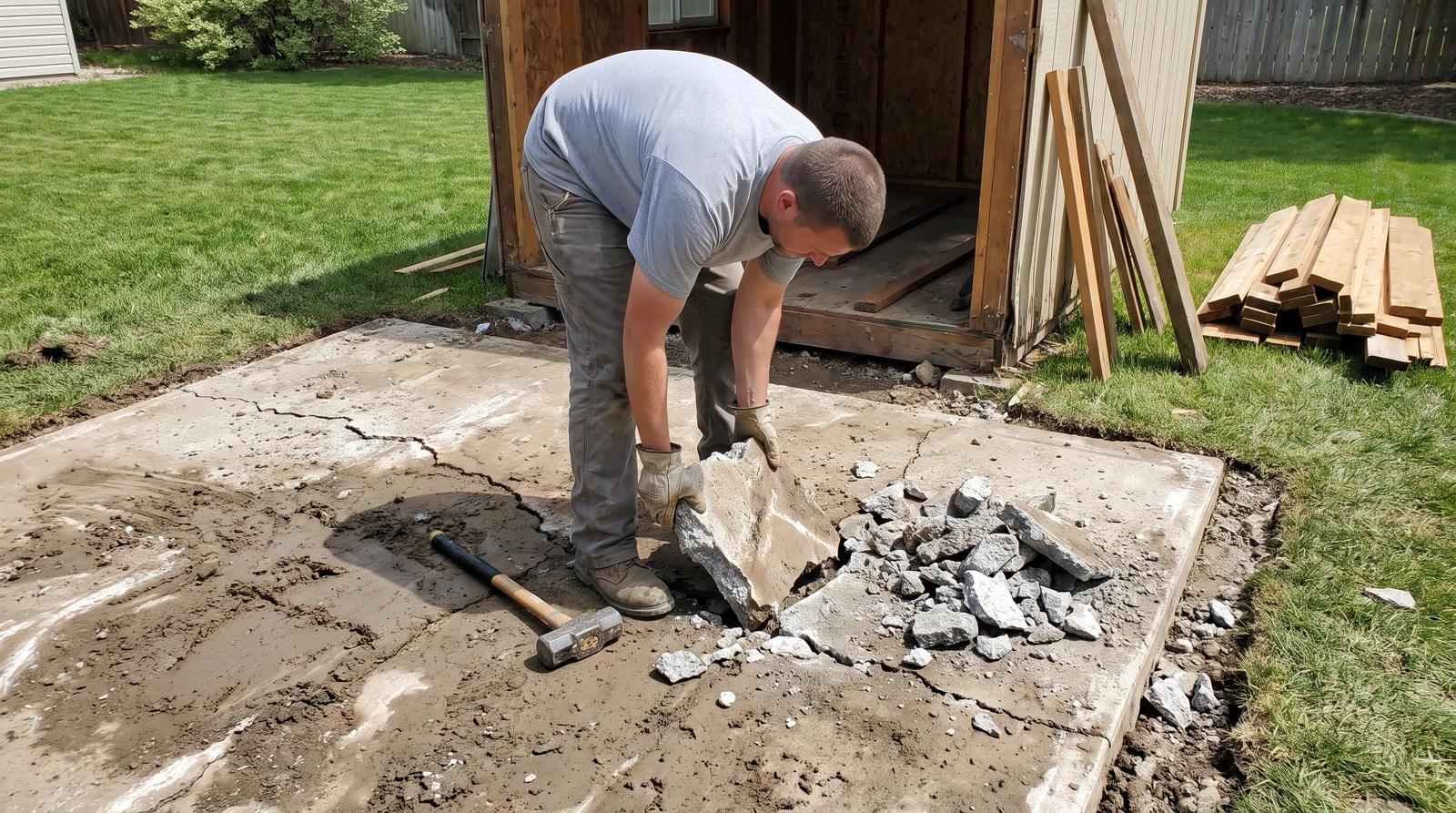
We break the concrete into pieces small enough to carry, cut out any rebar or wire mesh, and load it all up. A thin hand-mixed pad goes fast. A thick one with steel in it takes real time and heavier tools.
Then there's whatever is underneath. It's usually a layer of gravel, though we've also found old lumber, a mouse nest or two, and stuff that got buried when the pad was poured. We clear it out and rough-grade the spot so you're not left with a hole.
The ground itself varies a lot across the valley. Out in Kuna and parts of south Nampa it's hard and rocky, while some North End yards are soft and easy to level afterward. It doesn't change the demo much, but it does change how the finished spot looks.
The concrete doesn't just get tossed, either. Clean concrete can be crushed and reused as road base, so we haul it to a recycler instead of the Ada County landfill. Scrap metal from a steel shed gets recycled too.
Timing, permits and what it costs
Most slab jobs get on the schedule within a few days of the estimate, and sometimes we can do it the same day. Spring and fall are the easiest seasons. In August the ground around the pad bakes hard, and in January a frozen slab is more stubborn to break, though we work year-round.
Permits are a fair question. Pulling out a small detached shed and its pad often doesn't need one, but the rules aren't the same in Boise, Caldwell, Ada County or Canyon County, and they do change.
If the shed ever had electrical service, that line needs to be disconnected the right way. When in doubt, a quick call to your city's building department settles it. If we see something on your property that looks like it needs a permit, we'll say so during the estimate.
As for price, it depends on the size and thickness of the slab, whether there's rebar, how easy it is to reach, and how much material goes out. That's why we don't quote it over the phone.
We come out, look at it, and give you a firm price before anything gets touched. No add-ons halfway through. You can pay by cash, card or Venmo when we're done.
The bottom line
A slab in good shape is worth keeping if you've got a plan for it. If it's cracked, heaved, draining the wrong way or sitting where you want grass, it's easiest to take it out while we're already there for the shed.
Not sure which kind you've got? Give us a call at (208) 279-2738. We'll come take a look, tell you what we'd do if it were our yard, and price it both ways. No pressure either way.
Want a Free Quote?
We'll come look at your shed and give you a firm price. No pressure, no obligation. Then you can decide if DIY or professional makes more sense for your situation.
Call (208) 279-2738 for Free EstimateServing Boise, Meridian, Nampa, Caldwell, Eagle, and surrounding areas
More From Our Blog
Old Outbuilding and Shed Removal in Boise After You Move In
Bought a Boise-area home with an old shed or outbuilding out back? Here's what to check, what permits to ask about, and how the teardown actually goes.
How Much Does Shed Removal Cost in Boise?
Wondering what shed removal costs in Boise? Get real pricing for different shed sizes and materials.
DIY vs Professional Shed Demolition
Thinking about tearing down that shed yourself? Here's an honest look at DIY vs hiring pros.